
The Expanding Universe — a hands-on cosmology mini-course
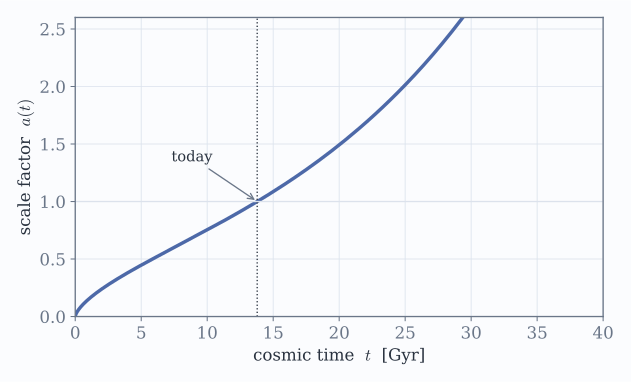
The whole story in one curve: how the size of the universe, the scale factor \(a(t)\), has grown with cosmic time. Every number in this plot comes out of Cosmic.jl. We spend this course learning to read it.
This is a five-part reading of Daniel Baumann's Cosmology (2021) — the first four parts follow Chapter 2, on the homogeneous universe; the fifth goes one chapter further, into how small inhomogeneities grow into the structure we actually see. I follow the book's structure and notation closely, but with one addition: at every stage we don't just write the equation, we solve it on a computer and check the number, using my own cosmology library Cosmic.jl. Theory on the left, a plot from real code on the right.
The philosophy of the package is worth stating up front, because it shapes how we work. A cosmology, in Cosmic, is nothing but a list of species — photons, baryons, cold dark matter, neutrinos, dark energy — each of which knows only its own energy density \(\rho_s(a)\) as a function of the scale factor. Everything else (the expansion rate, every distance, the thermal history) is derived from that list:
\[ \left(\frac{H(a)}{H_0}\right)^2 \;=\; \sum_s \frac{\rho_s(a)}{\rho_{c,0}} \;\equiv\; E(a)^2 . \]So when we "verify with Cosmic.jl," we are really watching the Friedmann equation do its job.
The five parts
1 · Geometry
Homogeneity and isotropy force the metric of the universe into a single shape: the Robertson–Walker line element. One function of time \(a(t)\), one number \(k\) for the curvature.
2 · Kinematics
How light and free particles move through the expanding spacetime: geodesics, redshift, and the several different "distances" a cosmologist has to keep straight.
3 · Dynamics
What makes \(a(t)\) do what it does: perfect fluids, the Friedmann equations, and the exact solutions for a radiation-, matter- and \(\Lambda\)-dominated universe.
4 · Our Universe
The measured numbers: the cosmic energy budget, the age, matter–radiation equality, and a first look at the thermal history — Cosmic.jl versus Baumann's Table 2.1.
5 · Perturbations
The universe isn't perfectly smooth — and that's why we exist. How tiny density ripples grow under gravity, from Newtonian dust to the full relativistic treatment, into the galaxies and the matter power spectrum we measure.
How to follow along
Everything below is reproducible. Install the package and open a REPL:
using Pkg
Pkg.add(url="https://github.com/aburousan/Cosmic.jl")
using Cosmic

c = cosmology()          # Planck 2018 ΛCDM
age(c)                   # ≈ 13.8 Gyr
Each part ends with the exact snippet that produced its figures, so you can change a parameter and watch the universe respond.