
The Philosophy of Beauty
Exploring the elegant intersection of Mathematics and Physics
Mathematics and Physics... These two are really something I enjoy. Each time I read something of maths or physics, it really forces me to think how beautiful and elegant things are. How can something born from our mind describe this world so perfectly?

Image taken by my friend Subham Chakraborty
This fascination forces me to always try to find patterns and beauty in the theories. Through this website, I want to show others exactly how beautiful these fields can be.
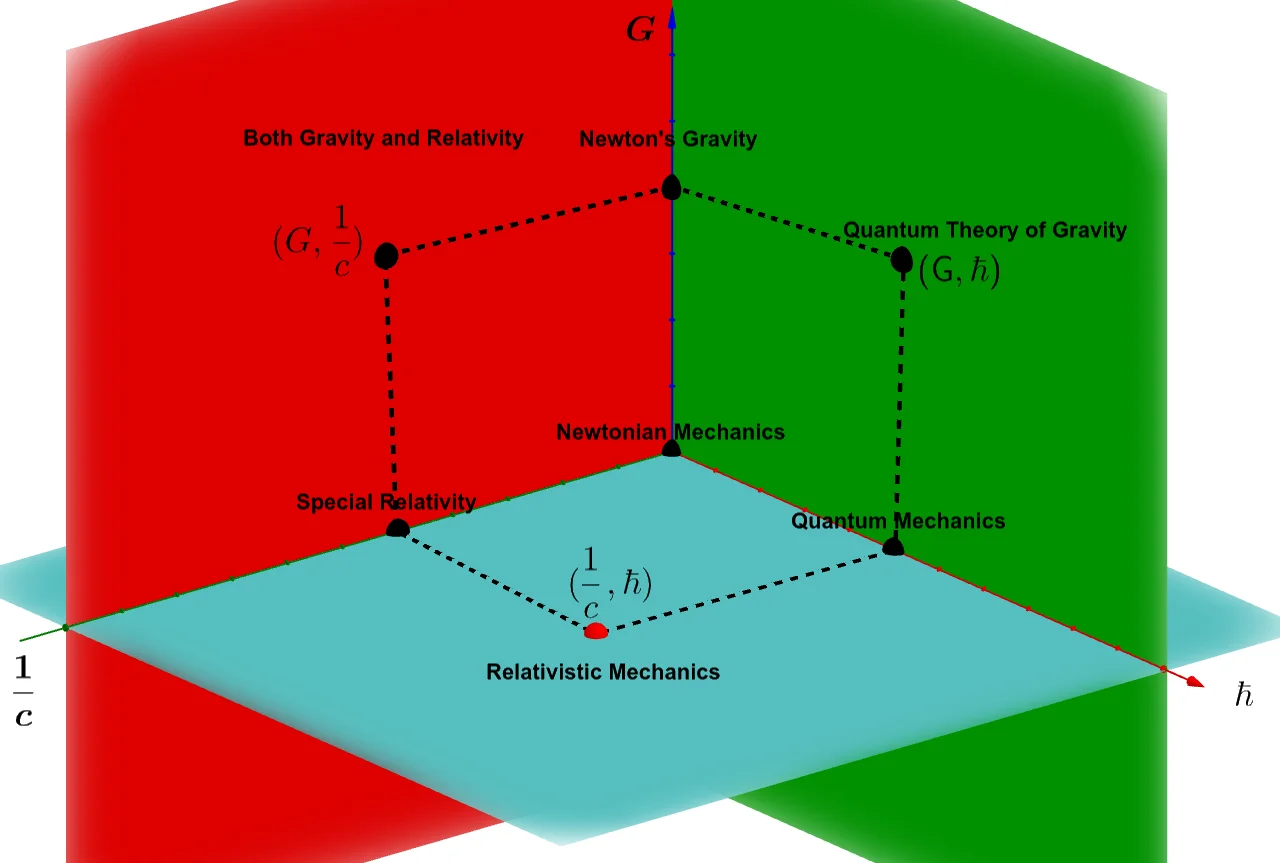
Here is a map of different fields of physics, and I love to run around all the parts.
"Two things are infinite: the universe and human stupidity; and I'm not sure about the universe.
A Ode to Physics
In the realm of particles, small and grand,
Quantum Field Theory, a mathematical stand,
Group theory dances with symmetries bright,
Unraveling particles, in quarks their flight.
Lie algebras and representations intertwine,
Mapping the forces, a mathematical shrine,
Gauge symmetries weave through QFT's tale,
Unifying particles, in equations frail.
Through fields and groups, a new world appears,
Where mathematical beauty conquers all fears,
In quantum realms, symmetries hold sway,
QFT and group theory, their dance will stay.
Recently Published
feynsage: a Tutorial for Someone Starting QFT
A tutorial for feynsage, a SageMath package for QFT calculations, in the order a first course actually goes: gamma matrices and traces first, then a full scattering cross section for electron positron to muon pair, then loops at the end. Every object is explained before it is used and every output on the page is captured from a real run.
Effective Field Theory, Starting From the Propagator You Just Learned
An effective field theory is what you get when you cannot afford the energy to make a heavy particle. This is EFT for someone a few weeks into a first QFT course: one line of algebra on the propagator you already know, one heavy scalar integrated out by hand, then Fermi's theory of beta decay, why non-renormalisable is not an insult, then how a theory predicts the energy at which it will stop working.
The Renormalisation Group: from Block Spins to Running Couplings
An eight-part beginner's course on the renormalisation group, in simple words with an everyday picture for every idea: loops and cutoffs from scratch, block spins and the Ising chain, fixed points and universality, Wilson's momentum shells, the Wilson-Fisher fixed point, running couplings in QED and QCD, then effective field theory. Every formula checked in Wolfram and FORM, with live simulations in the browser.
Tree Codes: Recreating Hernquist (1987)
Recreating Hernquist's 1987 paper on the performance of Barnes-Hut tree codes, from scratch in Julia: the Plummer model, the leapfrog integrator, the multipole expansion and every timing and error test in the paper.
Minkowski Functionals: Measuring the Shape of the Universe
A first-principles guide to Minkowski functionals: from 'what is shape?' through Hadwiger's theorem, curvature, the Steiner inflation formula, and the Hermite-ladder Gaussian predictions, to measuring non-Gaussianity in cosmology. Physical analogies (a flooding landscape), full derivations, symbolic checks in SymPy and WolframScript, numerical checks in Python and Julia, and an interactive 3D water-level widget.
Grassmann Algebra: Multiplying with Area and Orientation
A friendly, visual introduction to Grassmann (exterior) algebra: the wedge product, bivectors, orientation, multivector grades, and the tensor-algebra quotient definition — with runnable SageMath and SymPy code. The first part of a mini-series leading to Clifford algebras and spinors.