
- First, What Is the Weak Force?
- The Dirac Equation and Weyl Spinors
- Chirality (\(\gamma^5\))
- Helicity (\(h\))
- Parity Violation and the Weak Force
- The Resolution: Massive Neutrinos and Parity
- Giving the Neutrino Mass: Dirac vs Majorana
- Experimental Reality: From Weyl to Oscillations
- Conclusion
- Sources and further reading
Chirality, Helicity, and Why the Weak Force is Left-Handed
The discovery of neutrino oscillations proved that neutrinos have mass, overturning the original Standard Model assumption that they were purely massless. That single fact reopens a set of beautiful, subtle questions about the weak interaction — questions about chirality, helicity, and parity violation that are very easy to state sloppily and surprisingly delicate to get right.
In this post we define these three ideas carefully, using the machinery of Quantum Field Theory, and follow the consequences of giving the neutrino a mass all the way down to real numbers. The punchline, stated up front:
First, What Is the Weak Force?
Before any spinor algebra, let us get our bearings the way the early reviews did (this framing follows J. C. Taylor's 1964 The theory of weak interactions). Nature has four fundamental forces, and the weak interaction is the one responsible for radioactive decay. Its oldest example is the beta decay of a neutron,
\[ n \to p + e^- + \bar{\nu}, \]together with the decays of the muon and the charged pion, \(\mu^- \to e^- + \bar\nu + \nu\) and \(\pi^+ \to \mu^+ + \nu\).
Two features define the weak force and make it strange:
The modern way to package these facts is in three statements, which are exactly what we will unpack: the neutrino is two-component (it comes in only one handedness), the weak force couples to the left-chiral part of every fermion (the "\(1-\gamma^5\)" structure), and lepton number is conserved. Everything below is the careful version of those words.
The Dirac Equation and Weyl Spinors
Spin-\(\tfrac12\) particles like the electron and neutrino are described by the Dirac equation:
\[ (i\gamma^\mu \partial_\mu - m)\psi = 0 \]The field \(\psi\) is a 4-component spinor, and the \(\gamma^\mu\) are \(4\times4\) matrices obeying the Clifford algebra \(\{\gamma^\mu,\gamma^\nu\} = 2\eta^{\mu\nu}\). To make "handedness" manifest, we use the chiral (Weyl) representation:
\[ \gamma^0 = \begin{pmatrix} 0 & I \\ I & 0 \end{pmatrix}, \qquad \gamma^i = \begin{pmatrix} 0 & \sigma^i \\ -\sigma^i & 0 \end{pmatrix} \]where \(\sigma^i\) are the Pauli matrices. In this basis the 4-component spinor splits cleanly into two 2-component pieces,
\[ \psi = \begin{pmatrix} \psi_L \\ \psi_R \end{pmatrix}, \]and the Dirac equation becomes two coupled equations:
\[ \begin{aligned} i(\partial_0 - \vec{\sigma}\cdot\vec{\nabla})\psi_L - m\psi_R &= 0, \\ i(\partial_0 + \vec{\sigma}\cdot\vec{\nabla})\psi_R - m\psi_L &= 0. \end{aligned} \]Chirality (\(\gamma^5\))
Chirality is a fundamental, Lorentz-invariant property of a field. We define the chirality operator
\[ \gamma^5 = i\gamma^0\gamma^1\gamma^2\gamma^3 = \begin{pmatrix} -I & 0 \\ 0 & I \end{pmatrix}, \]which satisfies \((\gamma^5)^2 = I\), so its eigenvalues are \(\pm 1\). From it we build the chiral projection operators
\[ P_L = \frac{1-\gamma^5}{2} = \begin{pmatrix} I & 0 \\ 0 & 0 \end{pmatrix}, \qquad P_R = \frac{1+\gamma^5}{2} = \begin{pmatrix} 0 & 0 \\ 0 & I \end{pmatrix}. \]Applied to \(\psi\), these simply pick out the upper and lower blocks:
\[ P_L\psi = \begin{pmatrix}\psi_L\\0\end{pmatrix}\equiv\psi_L, \qquad P_R\psi = \begin{pmatrix}0\\\psi_R\end{pmatrix}\equiv\psi_R. \]A state is left-chiral if \(\gamma^5\psi_L = -\psi_L\) and right-chiral if \(\gamma^5\psi_R = +\psi_R\). Because \(\gamma^5\) commutes with Lorentz boosts, chirality is Lorentz invariant — every observer agrees on it.
We can check every one of these algebraic claims with a few lines of Julia. In the chiral basis \(\gamma^5 = \mathrm{diag}(-I,+I)\), so the projectors are just integer matrices:
using LinearAlgebra
I2 = Matrix{Int}(I, 2, 2);  Z2 = zeros(Int, 2, 2)
γ5 = [-I2  Z2;  Z2  I2]                 # chiral basis:  diag(-I, +I)
Id = Matrix{Int}(I, 4, 4)
P_L = (Id - γ5) .÷ 2                     # (1 - γ5)/2
P_R = (Id + γ5) .÷ 2                     # (1 + γ5)/2

println("γ5² = I            : ", γ5^2 == Id)
println("P_L + P_R = I       : ", P_L + P_R == Id)
println("P_L is a projector  : ", P_L^2 == P_L)      # P_L² = P_L
println("P_R is a projector  : ", P_R^2 == P_R)
println("P_L P_R = 0 (orthog): ", all(P_L*P_R .== 0))
println("\ndiag(P_L) = ", diag(P_L), "   # keeps the UPPER block → ψ_L")
println("diag(P_R) = ", diag(P_R), "   # keeps the LOWER block → ψ_R")
γ5² = I : true
P_L + P_R = I : true
P_L is a projector : true
P_R is a projector : true
P_L P_R = 0 (orthog): true
diag(P_L) = [1, 1, 0, 0] # keeps the UPPER block → ψ_L
diag(P_R) = [0, 0, 1, 1] # keeps the LOWER block → ψ_R
Every identity comes back true: the projectors are complete (\(P_L+P_R=1\)), idempotent (\(P_L^2=P_L\)), and orthogonal (\(P_LP_R=0\)) — the algebraic fingerprint of "splitting a field into two independent halves."
Helicity (\(h\))
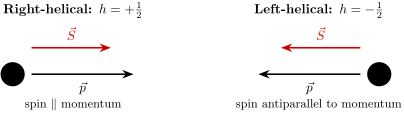
Helicity is the physically measurable projection of spin onto the direction of motion:
\[ h = \frac{\vec{\Sigma}\cdot\vec{p}}{2|\vec{p}|}, \qquad \vec{\Sigma} = \begin{pmatrix}\vec{\sigma} & 0 \\ 0 & \vec{\sigma}\end{pmatrix}. \]Spin aligned with momentum gives \(h=+\tfrac12\) (right-helical); anti-aligned gives \(h=-\tfrac12\) (left-helical).
Here is the catch:
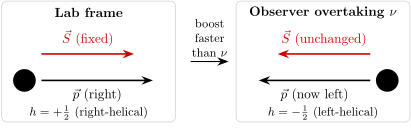
Connecting Chirality and Helicity
Take a free plane-wave solution \(u(p)e^{-ip\cdot x}\). In the chiral basis the spinor is
\[ u(p) = \begin{pmatrix}\sqrt{p\cdot\sigma}\,\xi \\ \sqrt{p\cdot\bar{\sigma}}\,\xi\end{pmatrix}, \qquad p\cdot\sigma = E - \vec{p}\cdot\vec{\sigma}, \quad p\cdot\bar{\sigma} = E + \vec{p}\cdot\vec{\sigma}, \]with \(\xi\) a 2-component rest-frame spinor. For a purely left-chiral field (\(\psi_R=0\)), the helicity expectation value turns out to be
\[ \langle h\rangle_L = -\frac12\,\frac{v}{c}, \qquad v = \frac{|\vec{p}|}{E}. \]This is the central result, and it is worth deriving without skipping steps.
Step 1 — build a helicity eigenstate. Put the momentum along \(z\), \(\vec{p}=p\,\hat z\), so \(h = \tfrac12\,\mathrm{diag}(\sigma_z,\sigma_z)\). The negative-helicity 2-spinor solves \(\sigma_z\xi_- = -\xi_-\):
\[ \xi_- = \begin{pmatrix}0\\1\end{pmatrix}, \qquad \sigma_z\xi_- = -\xi_-, \qquad \xi_-^\dagger\xi_- = 1. \]Step 2 — evaluate the square-root blocks. With \(\vec{p}\cdot\vec{\sigma} = p\,\sigma_z\), acting on \(\xi_-\):
\[ \begin{aligned} p\cdot\sigma\,\xi_- &= (E - p\,\sigma_z)\xi_- = (E+p)\,\xi_-, \\ p\cdot\bar\sigma\,\xi_- &= (E + p\,\sigma_z)\xi_- = (E-p)\,\xi_-. \end{aligned} \]Since \(\xi_-\) is an eigenvector, the square roots act as numbers, and
\[ u_-(p) = \begin{pmatrix}\sqrt{E+p}\,\xi_- \\ \sqrt{E-p}\,\xi_-\end{pmatrix}. \]Step 3 — project onto each chirality.
\[ P_L u_- = \begin{pmatrix}\sqrt{E+p}\,\xi_-\\0\end{pmatrix}, \qquad P_R u_- = \begin{pmatrix}0\\\sqrt{E-p}\,\xi_-\end{pmatrix}, \]so the squared norms are
\[ |P_L u_-|^2 = E+p, \qquad |P_R u_-|^2 = E-p, \qquad u_-^\dagger u_- = 2E. \]Step 4 — norms become probabilities, and \(v/c\) appears.
\[ P_L = \frac{E+p}{2E}, \qquad P_R = \frac{E-p}{2E}. \]Using \(E^2 = p^2 + m^2\) we have \(\dfrac{p}{E} = \sqrt{1-(m/E)^2} = \dfrac{v}{c}\), so
\[ P_L = \frac{1+v/c}{2}, \qquad P_R = \frac{1-v/c}{2}. \]Step 5 — the chirality expectation value. Since \(\gamma^5\) gives \(-1\) on the upper block and \(+1\) on the lower,
\[ \langle\gamma^5\rangle = \frac{(-1)(E+p) + (+1)(E-p)}{2E} = P_R - P_L = -\frac{v}{c} = 2h\,\frac{v}{c}\quad(h=-\tfrac12). \]Step 6 — read it backwards. A purely left-chiral field is the upper block alone, which receives contributions from both helicity spinors. The helicity is therefore distributed with
\[ P(h=-\tfrac12) = \frac{1+v/c}{2}, \qquad P(h=+\tfrac12) = \frac{1-v/c}{2}, \]and the mean helicity of the left-chiral coupling is
\[ \langle h\rangle_L = \left(-\tfrac12\right)\frac{1+v/c}{2} + \left(+\tfrac12\right)\frac{1-v/c}{2} = -\frac12\,\frac{v}{c}, \]exactly as claimed. The factor of two between \(\langle h\rangle_L = -\tfrac12\,v/c\) and \(\langle\gamma^5\rangle = -v/c\) is just the difference between helicity eigenvalues \(\pm\tfrac12\) and chirality eigenvalues \(\pm1\).
The two limiting cases:
Massless (\(v=c\)): \(\langle h\rangle_L = -\tfrac12\) exactly. A left-chiral state is perfectly and exclusively left-helical.
Massive neutrino (\(v\approx c\)): with \(m < 1\) eV and \(E\sim\mathcal{O}(\text{MeV})\), we have \(v/c = 1-\epsilon\) with \(\epsilon\sim 10^{-14}\). The left-chiral state is overwhelmingly left-helical, with a microscopic right-helical sliver suppressed by \((m/E)\).
Summary of values: every case spelled out
First, the two quantities are fundamentally different objects:
| Quantity | Operator | Eigenvalues | Lorentz invariant? | Conserved (free)? |
|---|---|---|---|---|
| Chirality | \(\gamma^5\) | \(+1\) (R), \(-1\) (L) | yes | only if \(m=0\) |
| Helicity | \(h=\tfrac12\vec\Sigma\cdot\hat p\) | \(+\tfrac12,\,-\tfrac12\) | only if \(m=0\) | yes |
Next, the actual numbers. Chirality content of a helicity eigenstate:
| Prepared state | \(P_L\) | \(P_R\) | \(\langle\gamma^5\rangle\) |
|---|---|---|---|
| \(h=-\tfrac12\), massless | \(1\) | \(0\) | \(-1\) |
| \(h=+\tfrac12\), massless | \(0\) | \(1\) | \(+1\) |
| \(h=-\tfrac12\), massive | \(\tfrac{1+v/c}{2}\) | \(\tfrac{1-v/c}{2}\) | \(-v/c\) |
| \(h=+\tfrac12\), massive | \(\tfrac{1-v/c}{2}\) | \(\tfrac{1+v/c}{2}\) | \(+v/c\) |
Helicity content of a chirality eigenstate (the mirror image, related by \(L\leftrightarrow R\)):
| Prepared state | \(P(h{=}{-}\tfrac12)\) | \(P(h{=}{+}\tfrac12)\) | \(\langle h\rangle\) |
|---|---|---|---|
| Left-chiral, massless | \(1\) | \(0\) | \(-\tfrac12\) |
| Right-chiral, massless | \(0\) | \(1\) | \(+\tfrac12\) |
| Left-chiral, massive | \(\tfrac{1+v/c}{2}\) | \(\tfrac{1-v/c}{2}\) | \(-\tfrac12 v/c\) |
| Right-chiral, massive | \(\tfrac{1-v/c}{2}\) | \(\tfrac{1+v/c}{2}\) | \(+\tfrac12 v/c\) |
The four physically distinct statements: (i) a massless left-chiral particle is exactly and only \(h=-\tfrac12\); (ii) a massive \(h=-\tfrac12\) particle is mostly left-chiral with a right-chiral fraction \((1-v/c)/2\); (iii) a massive left-chiral particle is mostly \(h=-\tfrac12\) with a wrong-helicity fraction \((1-v/c)/2\approx(m/2E)^2\); and (iv) everything is tied together by \(\langle\gamma^5\rangle = 2h\,(v/c)\).
Numerical reality check: why chirality \(\approx\) helicity
Expanding the velocity for a relativistic particle,
\[ \frac{v}{c} = \sqrt{1-\left(\frac{m}{E}\right)^2} \approx 1 - \frac12\left(\frac{m}{E}\right)^2, \]the deviation of the helicity from its ideal value is
\[ \left|\langle h\rangle_L + \frac12\right| = \frac14\left(\frac{m}{E}\right)^2. \]More physically, when the weak vertex projects out \(P_L\), the probability of producing the wrong (right-helical) neutrino is
\[ P_{\text{wrong}} = \frac{E-p}{2E} = \frac{m^2}{2E(E+p)} \approx \left(\frac{m}{2E}\right)^2. \]Anchoring to oscillation data — the atmospheric splitting \(\Delta m^2_{31}\approx 2.5\times10^{-3}\,\text{eV}^2\) guarantees a mass \(m\gtrsim 0.05\) eV, while KATRIN caps \(m\lesssim 0.45\) eV — gives:
| Source | \(E\) | \(m\) | \(1-v/c\) | \(P_{\text{wrong}}=(m/2E)^2\) |
|---|---|---|---|---|
| Solar (pp) | \(0.42\) MeV | \(0.05\) eV | \(7.1\times10^{-15}\) | \(3.5\times10^{-15}\) |
| Reactor | \(4\) MeV | \(0.05\) eV | \(7.8\times10^{-17}\) | \(3.9\times10^{-17}\) |
| Accelerator | \(1\) GeV | \(0.05\) eV | \(1.3\times10^{-21}\) | \(6.3\times10^{-22}\) |
| KATRIN bound | \(1\) MeV | \(0.45\) eV | \(1.0\times10^{-13}\) | \(5.1\times10^{-14}\) |
Even in the most favourable case, fewer than one neutrino in \(10^{13}\) carries the wrong helicity.
Let's reproduce that table in Julia — with one numerical subtlety worth seeing. The "obvious" formula \(1-v/c = 1-\sqrt{1-(m/E)^2}\) suffers catastrophic cancellation: subtracting two numbers that agree to 16+ digits throws away all the precision. The algebraically equivalent \(1-v/c = \dfrac{(m/E)^2}{1+\sqrt{1-(m/E)^2}}\) is stable.
# (Energy E and mass m both in eV)
sources = [("Solar (pp)", 0.42e6, 0.05),
           ("Reactor",    4.0e6,  0.05),
           ("Accelerator", 1.0e9, 0.05),
           ("KATRIN max",  1.0e6,  0.45)]

naive(r)  = 1 - sqrt(1 - r^2)              # loses precision for tiny r
stable(r) = r^2 / (1 + sqrt(1 - r^2))      # algebraically identical, numerically safe

println(rpad("Source",13), rpad("1-v/c (naive)",16), rpad("1-v/c (stable)",16), "P_wrong=(m/2E)²")
for (name, E, m) in sources
    r  = m / E
    Pw = (m / (2E))^2
    println(rpad(name,13),
            rpad(string(round(naive(r),  sigdigits=2)),16),
            rpad(string(round(stable(r), sigdigits=2)),16),
            round(Pw, sigdigits=2))
end
Source 1-v/c (naive) 1-v/c (stable) P_wrong=(m/2E)²
Solar (pp) 7.1e-15 7.1e-15 3.5e-15
Reactor 1.1e-16 7.8e-17 3.9e-17
Accelerator 0.0 1.3e-21 6.2e-22
KATRIN max 1.0e-13 1.0e-13 5.1e-14
Notice the accelerator row: the naive column reads a flat 0.0 (all significant digits cancelled away), while the stable column correctly gives \(1.3\times10^{-21}\). The physics and the numerics teach the same lesson — the wrong-helicity rate is fantastically tiny, but it is not zero.
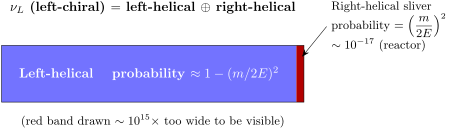
For a typical reactor neutrino \(v/c = 1 - 7.8\times10^{-17}\): it is slower than light by less than one part in \(10^{16}\). (As an independent check, the SN1987A neutrinos crossed \(\sim168{,}000\) light-years and arrived within hours of the photons.)
The decisive measurement: why the pion shuns the electron
All of the above could feel like bookkeeping — a \((m/2E)^2\) that is real but unmeasurably small. So it is worth meeting the one everyday process where the tiny gap between chirality and helicity is not just visible but spectacular: the decay of the charged pion. A \(\pi^+\) can decay two ways,
\[ \pi^+ \to \mu^+ + \nu_\mu, \qquad \pi^+ \to e^+ + \nu_e . \]Naively the electron channel should win in a landslide. The electron is \(\sim200\) times lighter than the muon, so there is far more phase space — more room for the decay products to fly apart — and ordinarily "more phase space" means "faster decay." Instead nature does the opposite. The electron mode is suppressed by a factor of about ten thousand:
\[ R_\pi \equiv \frac{\Gamma(\pi^+\to e^+\nu_e)}{\Gamma(\pi^+\to\mu^+\nu_\mu)} = \left(\frac{m_e}{m_\mu}\right)^{\!2}\left(\frac{m_\pi^2-m_e^2}{m_\pi^2-m_\mu^2}\right)^{\!2} \approx 1.28\times10^{-4}, \]in beautiful agreement with the measured \((1.230\pm0.004)\times10^{-4}\) (after a small radiative correction). That factor \((m_e/m_\mu)^2\) is the very \((m/E)\) helicity–chirality mismatch from above, caught red-handed in a number you can look up in the Particle Data Group.
Parity Violation and the Weak Force
A parity transformation \(P\) sends \(\vec{x}\to-\vec{x}\). It reverses momentum (\(\vec{p}\to-\vec{p}\), a polar vector) but leaves spin (an axial vector) unchanged. Therefore parity flips helicity:
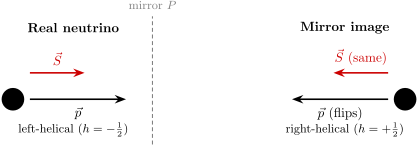
On a Dirac spinor, parity is represented by \(\gamma^0\), i.e. \(\psi(t,\vec{x})\to\gamma^0\psi(t,-\vec{x})\). Acting on a left-chiral state,
\[ P(\psi_L) = \gamma^0\begin{pmatrix}\psi_L\\0\end{pmatrix} = \begin{pmatrix}0 & I \\ I & 0\end{pmatrix}\begin{pmatrix}\psi_L\\0\end{pmatrix} = \begin{pmatrix}0\\\psi_L\end{pmatrix} = \text{right-chiral}. \]So parity flips chirality too.
The Weak Interaction (V−A Theory)
In 1956 Lee and Yang asked the heretical question — has parity ever actually been tested in weak decays? — and found that it had not. Within months Wu and collaborators answered it. They took a sample of \(^{60}\)Co and aligned the nuclear spins with a magnetic field at \(0.02\) K (cold enough that thermal jostling did not scramble the alignment), then watched which way the beta-decay electrons came out:
In the Standard Model this maximal violation is built into the charged-current vertex coupling a neutrino, an electron, and the \(W\)-boson:
\[ \mathcal{L}_{\text{int}} \propto \bar{e}\,\gamma^\mu(1-\gamma^5)\,\nu\,W_\mu. \]The factor \((1-\gamma^5)\) is exactly twice the left projector, \(\tfrac{1-\gamma^5}{2}\nu = \nu_L\). So:
The Group-Theory Argument: Singlets, Doublets, Triplets
Start from what the force actually does. The weak interaction turns each particle into a partner: a \(W\) boson knocks an electron into a neutrino, or a down quark into an up quark — and back again,
\[ \nu_L \leftrightarrow e_L, \qquad u_L \leftrightarrow d_L. \]So the natural objects are not single particles but pairs. Now ask the one question that fixes everything: what transformations can mix the two members of a pair while keeping the total probability fixed (so the result is still a valid quantum state)? Those are exactly the \(2\times2\) unitary rotations; peel off the overall phase (which belongs to a separate \(U(1)\)) and what is left is \(SU(2)\). That is the whole reason the weak force is an "\(SU(2)\)" theory — it shuffles things two at a time.
Because \(SU(2)\) is the same algebra as ordinary spin, \([T^a,T^b]=i\,\epsilon^{abc}\,T^c\), we can borrow all the spin vocabulary. A multiplet is just a family of particles that the weak rotations shuffle among themselves, and only three sizes ever appear — and the size is \(2T+1\), exactly as a spin-\(T\) object has \(2T+1\) orientations:
Singlet — a loner (size \(1\)). The rotations do nothing to it (\(T^a=0\)): it carries no weak charge and never feels the \(W\). The right-chiral fields \(\nu_R, e_R\) live here.
Doublet — a pair (size \(2\)) such as \((\nu_L, e_L)\), rotated into each other exactly like the spin-up/spin-down states of a spin-\(\tfrac12\) particle. Turning the lower member into the upper one is the emission of a \(W\). The left-chiral fields live here.
Triplet — a trio (size \(3\)), and here is the nice twist: the \(W\) bosons themselves form a triplet. There are exactly three of them — \(W^+, W^-, W^3\) — because \(SU(2)\) has exactly three independent rotations. The charged ones are the raising/lowering combinations \(W^\pm = \tfrac{1}{\sqrt2}(W^1 \mp iW^2)\) that flip a doublet's members, while \(W^3\) mixes with the hypercharge boson to make the photon and the \(Z\).
Up to here, nothing has chosen a handedness — this is all just "spin" bookkeeping. The single physical input — and the entire content of parity violation — is the assignment: nature places the left-chiral fermions in doublets and leaves the right-chiral ones as singlets,
\[ SU(2)_L \ \text{rotates}\ \begin{pmatrix}\nu_L\\ e_L\end{pmatrix}, \qquad \text{while}\ \nu_R,\ e_R\ \text{sit alone, untouched.} \]The mathematics never demanded "left"; that asymmetry is precisely what the 1957 Wu experiment measured.
How the coupling is generated — step by step. Gauge invariance has exactly one rule: replace every ordinary derivative by the covariant derivative
\[ D_\mu = \partial_\mu - i g\,T^a W^a_\mu , \]where \(T^a\) is the generator in whatever representation the field sits in. Plugging this into the free kinetic term \(\bar\psi\,i\gamma^\mu D_\mu\psi\) splits it into a free piece plus an interaction,
\[ \bar\psi\,i\gamma^\mu D_\mu\psi = \underbrace{\bar\psi\,i\gamma^\mu\partial_\mu\psi}_{\text{free}} \;+\; \underbrace{g\,\bar\psi\,\gamma^\mu T^a\psi\,W^a_\mu}_{\mathcal{L}_{\text{int}}} . \]Now feed in the actual representations. (1) A right-chiral field is a singlet, \(T^a=0\), so its entire interaction term is identically zero — \(\nu_R\) and \(e_R\) never appear in a weak vertex. (2) The left-chiral fields form the doublet \(L=\binom{\nu_L}{e_L}\) with \(T^a=\tfrac12\sigma^a\), so writing the interaction out with the Pauli matrices,
\[ \mathcal{L}_{\text{int}} = \tfrac{g}{2}\,\bar L\,\gamma^\mu\,\sigma^a L\;W^a_\mu . \]The three \(\sigma^a\) do three different jobs. The combinations \(\sigma^\pm=\tfrac12(\sigma^1\pm i\sigma^2)\) are the off-diagonal raising/lowering matrices that swap the two doublet members,
\[ \sigma^+ = \begin{pmatrix}0&1\\0&0\end{pmatrix},\qquad \sigma^+\binom{\nu_L}{e_L} = \binom{e_L}{0}, \]so \(\sigma^\pm\) paired with \(W^\pm_\mu=\tfrac1{\sqrt2}(W^1_\mu\mp iW^2_\mu)\) turn an electron into a neutrino (and back) — the charged current. The diagonal \(\sigma^3\) paired with \(W^3_\mu\) keeps each member as itself — the neutral current. Extracting just the charged piece,
\[ \mathcal{L}_{\text{CC}} = \frac{g}{\sqrt2}\,\bar\nu_L\,\gamma^\mu e_L\,W^+_\mu + \text{h.c.} \]Finally, undo the shorthand \(\nu_L = P_L\nu = \tfrac{1-\gamma^5}{2}\nu\) and slide the projector through the gamma matrix (using \(\gamma^\mu P_L = P_R\gamma^\mu\) and \(P_L^2=P_L\)) to recover the familiar \(V-A\) vertex acting on the full Dirac fields:
\[ \mathcal{L}_{\text{CC}} = \frac{g}{\sqrt2}\,\bar\nu\,\gamma^\mu\,\frac{1-\gamma^5}{2}\,e\,W^+_\mu + \text{h.c.} \]Parity violation is nothing more than the asymmetry of those representation matrices (\(T^a=\tfrac12\sigma^a\) for left, \(T^a=0\) for right). The \((1-\gamma^5)\) was never written by hand — it is just the algebraic memory that only the \(P_L\) halves of \(\nu\) and \(e\) were ever placed in the doublet.
Electric charge ties it together. With hypercharge \(Y\) under \(U(1)_Y\), the unbroken charge is \(Q = T^3 + Y\). For the lepton doublet \(Y=-\tfrac12\), giving \(Q=0\) (neutrino) and \(Q=-1\) (electron); the singlet \(e_R\) has \(T^3=0\), \(Y=-1\), hence \(Q=-1\) as well. The two electron chiralities share the same charge but live in different weak representations — which is exactly how electromagnetism stays parity-conserving while the weak force does not.
Quantifying "maximal" violation
A generic parity-violating theory couples to the two chiralities with strengths \(g_L, g_R\), and one defines the chiral asymmetry
\[ \mathcal{A} = \frac{g_L^2 - g_R^2}{g_L^2 + g_R^2}. \]A parity-conserving interaction (electromagnetism, QCD) has \(g_L=g_R\), so \(\mathcal{A}=0\). The charged-current weak interaction sets
\[ g_R = 0 \quad\Longrightarrow\quad \mathcal{A} = +1, \]a complete shut-off of one chirality — hence "maximal." The 1957 Wu experiment on polarized \(^{60}\)Co first measured the asymmetry; the 1958 Goldhaber experiment found the neutrino helicity to be \(-1\) within errors. Modern bounds on any right-handed current sit at \(g_R/g_L\lesssim10^{-2}\), consistent with the exact zero of the Standard Model.
The Resolution: Massive Neutrinos and Parity
Now we can resolve the apparent paradox:
Mass requires both chiralities. The Dirac mass term is
which couples left to right. If neutrinos have mass, a right-chiral component \(\nu_R\)must exist (a new sterile state, or the antineutrino itself in the Majorana case).
Parity violation survives anyway. The physical massive neutrino is a mixture of \(\nu_L\) and \(\nu_R\), but the weak force is oblivious to \(\nu_R\). The \(V-A\) vertex \(\gamma^\mu(1-\gamma^5)\) projects out only the left-chiral piece; the right-chiral component ghosts through untouched.
Giving the Neutrino Mass: Dirac vs Majorana
Before any Lagrangians, it helps to feel the Dirac–Majorana question physically. Both of the following are honest thought experiments that working physicists use, and both hinge on the one fact we have already established: for a massive neutrino, helicity is not Lorentz-invariant.
A closely related fact lives in a real detector. The antineutrinos from a reactor, \(\bar\nu_e\), are never seen to drive the reaction \(\bar\nu_e + {}^{37}\text{Cl}\to{}^{37}\text{Ar} + e^-\), even though the reaction itself exists in nature (it is how Davis caught solar neutrinos). The textbook reading is "\(\nu_e\) and \(\bar\nu_e\) are different particles." But notice the subtlety the chirality discussion forces on us: the \(\bar\nu_e\) is right-handed and the reaction wants a left-handed neutrino, so the non-observation could also be a helicity suppression of order \((m_\nu/E)^2\) — exactly the loophole a Majorana neutrino would exploit. Distinguishing "truly different particles" from "same particle, wrong helicity" is precisely what neutrinoless double beta decay is built to do.
Step 0 — why a mass term needs both chiralities
Everything below follows from one short calculation. A Dirac mass term is the Lorentz scalar
\[ \mathcal{L}_{\text{mass}} = -m\,\bar\psi\psi . \]Split the field into chiral halves, \(\psi = \psi_L + \psi_R\) with \(\psi_{L,R}=P_{L,R}\psi\), and expand:
\[ \bar\psi\psi = \bar\psi_L\psi_L + \bar\psi_L\psi_R + \bar\psi_R\psi_L + \bar\psi_R\psi_R . \]Now use the key identity \(\bar\psi_L = (P_L\psi)^\dagger\gamma^0 = \psi^\dagger P_L\gamma^0 = \psi^\dagger\gamma^0 P_R = \bar\psi\,P_R\) (because \(\gamma^5\) anticommutes with \(\gamma^0\), so \(P_L\gamma^0=\gamma^0P_R\)). The "same-chirality" pieces then vanish through the orthogonality \(P_RP_L=0\):
\[ \bar\psi_L\psi_L = \bar\psi\,P_R P_L\,\psi = 0, \qquad \bar\psi_R\psi_R = \bar\psi\,P_L P_R\,\psi = 0, \]leaving only the cross terms:
\[ \boxed{\ \bar\psi\psi = \bar\psi_L\psi_R + \bar\psi_R\psi_L\ }. \]A mass term is a handshake between left and right. A purely left-handed field cannot have a mass by itself — so to give the neutrino a mass we must supply a right-handed partner. There are exactly two ways to do it, and that is the whole Dirac-vs-Majorana question.
The two ways differ in whether they respect lepton number, so let us pin that idea down first.
Option A — Dirac mass (borrow a brand-new partner)
Introduce a new right-chiral field \(\nu_R\) that is a complete gauge singlet (no isospin, hypercharge, or colour — a sterile state). The handshake \(\bar\nu_L\nu_R\) is exactly what we need, but \(\nu_L\) lives in the doublet \(L=\binom{\nu_L}{e_L}\) (\(Y=-\tfrac12\)), so a bare \(\bar\nu_L\nu_R\) is not gauge invariant. We fix that with the Higgs doublet, exactly as the electron mass is built. Using the conjugate Higgs \(\tilde H = i\sigma^2 H^*\) (which carries \(Y=-\tfrac12\)), the combination \(\bar L\,\tilde H\,\nu_R\) is a complete \(SU(2)\times U(1)\) singlet:
\[ \mathcal{L}_{\text{Yuk}} = -\,y_\nu\,\bar L\,\tilde H\,\nu_R + \text{h.c.} \]When the Higgs gets its vacuum value \(\langle H\rangle=\binom{0}{v/\sqrt2}\), then \(\langle\tilde H\rangle=\binom{v/\sqrt2}{0}\), and the doublet contraction picks out the neutrino component,
\[ \bar L\,\langle\tilde H\rangle = (\bar\nu_L,\ \bar e_L)\binom{v/\sqrt2}{0} = \frac{v}{\sqrt2}\,\bar\nu_L , \]so the Yukawa term collapses to a Dirac mass:
\[ \mathcal{L}_{\text{Yuk}} \;\longrightarrow\; -\,\frac{y_\nu v}{\sqrt2}\,\bar\nu_L\nu_R + \text{h.c.} = -\,m_D\big(\bar\nu_L\nu_R + \bar\nu_R\nu_L\big), \qquad m_D = \frac{y_\nu v}{\sqrt2}. \]This conserves lepton number (\(\nu\) and \(\bar\nu\) stay distinct), but it has a naturalness problem. Inverting for the coupling with \(v=246\) GeV and the observed scale \(m_D\sim0.05\) eV,
\[ y_\nu = \frac{\sqrt2\,m_D}{v} \approx \frac{\sqrt2\,(0.05\ \text{eV})}{246\ \text{GeV}} \approx 2.9\times10^{-13}. \]Compared with the electron's Yukawa \(y_e = \sqrt2\,m_e/v \approx 2.9\times10^{-6}\), this is a factor
\[ \frac{y_\nu}{y_e} \approx \frac{m_\nu}{m_e} \approx \frac{0.05\ \text{eV}}{0.511\ \text{MeV}} \approx 10^{-7} \]smaller — a number the theory does not explain.
Option B — Majorana mass (be your own partner)
The neutrino is the only electrically neutral elementary fermion, and that opens a door closed to every charged particle. Recall charge conjugation, \(\psi^c \equiv C\bar\psi^{\,T}\) with \(C=i\gamma^2\gamma^0\). A crucial property is that it flips chirality,
\[ \big(P_L\psi\big)^c = P_R\,\psi^c , \]so \(\nu_L^c \equiv (\nu_L)^c\) transforms as a right-chiral field. We can therefore use it as the missing partner — no new field at all. The handshake of Step 0, with \(\psi_R\to\nu_L^c\), is the Majorana mass term:
\[ \mathcal{L}_M = -\frac12\,m_M\,\overline{\nu_L^c}\,\nu_L + \text{h.c.} \]Two dramatic consequences follow directly. First, because the term mixes \(\nu_L\) with its own conjugate, the mass eigenstate is the self-conjugate combination \(\nu_M=\nu_L+\nu_L^c\) obeying \(\nu_M^c=\nu_M\): the neutrino is its own antiparticle (\(\nu=\bar\nu\)). Second, \(\nu_L\) carries lepton number \(L=+1\) while \(\nu_L^c\) carries \(L=-1\), so the term changes lepton number by two units (\(\Delta L=2\)). The experimental signature is neutrinoless double beta decay (\(0\nu\beta\beta\)), currently bounding the effective mass \(\langle m_{\beta\beta}\rangle\lesssim 0.1\) eV.
There is a catch: \(\nu_L\) is not a gauge singlet (it carries weak isospin and \(Y=-\tfrac12\)), so \(m_M\,\overline{\nu_L^c}\nu_L\) is forbidden as a renormalizable term — its hypercharge does not cancel. It can only appear once two Higgs doublets soak up the quantum numbers, in the dimension-five Weinberg operator
\[ \mathcal{L}_5 = \frac{c}{\Lambda}\,\big(\bar L^c\,\tilde H^*\big)\big(\tilde H^\dagger L\big) \;\xrightarrow{\ \langle H\rangle\ }\; m_M \sim \frac{c\,v^2}{\Lambda}. \]The lone power of \(1/\Lambda\) marks it as non-renormalizable — a low-energy footprint of new physics at the scale \(\Lambda\). And notice the bonus: a large \(\Lambda\) makes \(m_M\)automatically tiny.
Best of both — the seesaw mechanism
That bonus is the heart of the seesaw. Keep the Dirac coupling \(m_D\), and give the sterile \(\nu_R\) its own Majorana mass \(M\) — which is allowed with no Higgs at all, precisely because \(\nu_R\) is a gauge singlet. Collecting \(\nu_L\) and \(\nu_R^c\) into a single two-component vector, the mass terms are
\[ \mathcal{L}_{\text{mass}} = -\frac12\,(\overline{\nu_L},\ \overline{\nu_R^c})\,\mathcal{M}\binom{\nu_L^c}{\nu_R} + \text{h.c.}, \qquad \mathcal{M} = \begin{pmatrix} 0 & m_D \\ m_D & M \end{pmatrix}. \]The entries say everything: the top-left \(0\) is the forbidden left-handed Majorana mass, the off-diagonal \(m_D\) is the Higgs-generated Dirac mass, and the bottom-right \(M\) is the allowed singlet Majorana mass. Diagonalize this symmetric \(2\times2\) matrix through its characteristic equation,
\[ \det(\mathcal{M}-\lambda\,\mathbb{I}) = \lambda^2 - M\lambda - m_D^2 = 0 \quad\Longrightarrow\quad \lambda_\pm = \frac{M \pm \sqrt{M^2 + 4m_D^2}}{2}. \]A quick check on the two roots: their sum is \(\lambda_+ + \lambda_- = M\) and their product is \(\lambda_+\lambda_- = -m_D^2\). Now take the physical hierarchy \(M \gg m_D\) (the sterile partner is heavy) and expand the square root, \(\sqrt{M^2+4m_D^2}\approx M\big(1+2m_D^2/M^2\big)\):
\[ m_{\text{heavy}} = \lambda_+ \approx M + \frac{m_D^2}{M}\approx M, \qquad m_{\text{light}} = |\lambda_-| \approx \frac{m_D^2}{M}. \](The product relation gives the same thing instantly: \(m_{\text{light}}\approx m_D^2/m_{\text{heavy}} = m_D^2/M\).) The observed neutrino is light because its partner is heavy — push one mass up and the other drops, hence "seesaw." Plugging in an electroweak-scale Dirac mass \(m_D\sim100\) GeV and a grand-unification-scale \(M\sim10^{15}\) GeV,
\[ m_{\text{light}} \sim \frac{(100\ \text{GeV})^2}{10^{15}\ \text{GeV}} = \frac{10^{4}\ \text{GeV}^2}{10^{15}\ \text{GeV}} = 10^{-11}\ \text{GeV} = 10^{-2}\ \text{eV}, \]landing squarely in the observed range with no unnaturally small coupling. The neutrino's tiny mass becomes evidence for physics at an enormous energy scale.
Experimental Reality: From Weyl to Oscillations
It is worth stepping back to see how dramatically the picture has changed — and how the experiments pin down every number we have used.
The 1964 picture: a massless, one-handed neutrino
In J. C. Taylor's 1964 review The theory of weak interactions, the neutrino was simply assumed massless, with only an upper bound \(m_\nu < 200\) eV from the endpoint of tritium beta decay. A massless spin-\(\tfrac12\) particle obeys the two-component Weyl equation
\[ (E + \vec\sigma\cdot\vec p)\,\phi = 0 \quad\Longrightarrow\quad E^2 = p^2, \]which forces spin and momentum to be exactly antiparallel: a single left circularly-polarised state. Weyl wrote this down in 1929 but it was rejected because it has no parity operation — and then revived in 1957 (Lee–Yang, Landau, Salam) precisely because a parity-violating force wanted exactly such a one-handed object. Where the Dirac equation has four states, the massless neutrino has only two: a left-handed particle and a right-handed antiparticle.
The modern picture: neutrinos oscillate, so they have mass
That tidy massless story broke when neutrinos were seen to oscillate — to change flavour in flight — which is only possible if the mass eigenstates \(\nu_1,\nu_2,\nu_3\) have different (hence nonzero) masses. Oscillation experiments do not measure the masses themselves, but the mass-squared splittings and the flavour mixing:
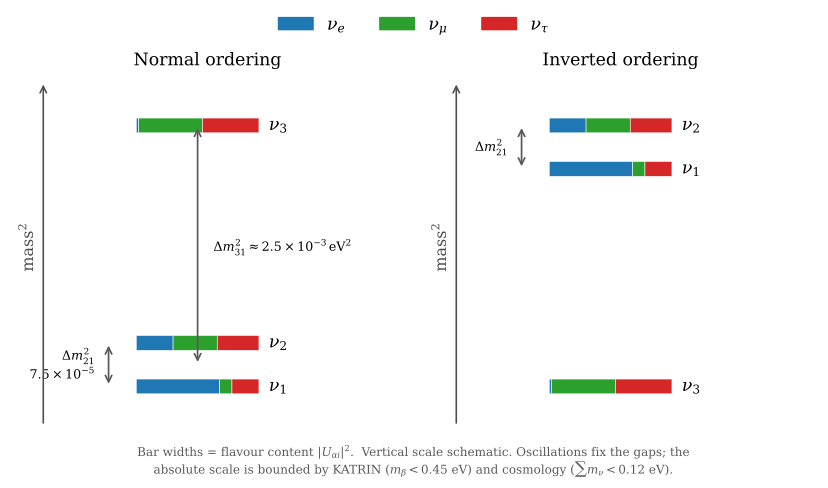
How to read this diagram, piece by piece. It packs four separate facts into one picture:
Each bar is a mass eigenstate. The three horizontal bars are \(\nu_1,\nu_2,\nu_3\) — the neutrinos of definite mass (as opposed to the flavour states \(\nu_e,\nu_\mu,\nu_\tau\) that the weak force produces). Their height on the page is the mass-squared \(m^2\). The vertical scale is schematic, not linear — drawn that way on purpose so the tiny solar gap is visible next to the \(\sim33\times\) larger atmospheric gap.
The two gaps are the measured quantities. Oscillations only ever see differences of \(m^2\): the small gap \(\Delta m^2_{21}=m_2^2-m_1^2\approx7.5\times10^{-5}\,\text{eV}^2\) (the "solar" splitting) and the large gap \(|\Delta m^2_{31}|=|m_3^2-m_1^2|\approx2.5\times10^{-3}\,\text{eV}^2\) (the "atmospheric" splitting).
The colours are the flavour content. The blue/green/red widths of each bar are \(|U_{ei}|^2,\,|U_{\mu i}|^2,\,|U_{\tau i}|^2\) — the probabilities that, if you caught that mass state in a detector, it would interact as a \(\nu_e\), \(\nu_\mu\), or \(\nu_\tau\) (the \(U_{\alpha i}\) are the entries of the PMNS mixing matrix). Notice \(\nu_1\) is mostly \(\nu_e\) (blue), \(\nu_3\) has almost no \(\nu_e\) — its blue sliver is \(|U_{e3}|^2\approx\sin^2\theta_{13}\approx0.02\) — and is split between \(\nu_\mu\) and \(\nu_\tau\), while \(\nu_2\) is a near-even mix. This very mismatch between mass states and flavour states is what makes oscillation happen: a \(\nu_e\) born in the Sun is a particular blend of \(\nu_1,\nu_2,\nu_3\) that drifts out of step as it travels, re-emerging partly as \(\nu_\mu\) or \(\nu_\tau\).
"Normal" vs "inverted" is one yes/no question. It is simply where the odd-one-out state \(\nu_3\) sits: at the top (normal ordering, \(\nu_3\) heaviest) or at the bottom (inverted, \(\nu_3\) lightest). Experiments have not yet decided which. And because only the gaps are measured, the whole ladder can slide up or down — its absolute floor (the lightest mass) is unknown, pinned only from above by KATRIN (\(m_\beta<0.45\) eV) and cosmology (\(\sum m_\nu<0.12\) eV).
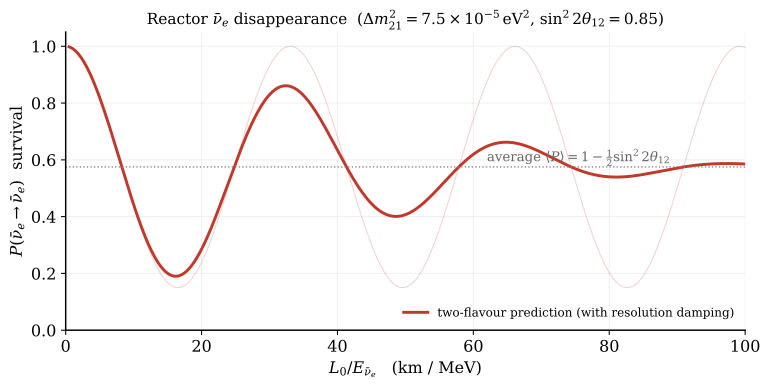
The direct evidence for all of this is the disappearance pattern: start with a beam of one flavour and the survival probability oscillates with \(L/E\). For reactor antineutrinos,
\[ P(\bar\nu_e\to\bar\nu_e) = 1 - \sin^2 2\theta_{12}\,\sin^2\!\left(\frac{\Delta m^2_{21}\,L}{4E}\right), \]which the KamLAND experiment observed beautifully as a function of \(L/E\):
Putting the experimental numbers in one place:
| Quantity | Value | Source |
|---|---|---|
| \(\Delta m^2_{21}\) (solar) | \(7.5\times10^{-5}\ \text{eV}^2\) | solar + KamLAND |
| \(|\Delta m^2_{31}|\) (atmospheric) | \(2.5\times10^{-3}\ \text{eV}^2\) | atmospheric + accelerator |
| lightest mass (from splittings) | \(m \gtrsim 0.05\ \text{eV}\) | guaranteed by \(\sqrt{\Delta m^2_{31}}\) |
| direct lab bound | \(m_\beta < 0.45\ \text{eV}\) | KATRIN (tritium endpoint) |
| cosmological bound | \(\textstyle\sum m_\nu < 0.12\ \text{eV}\) | CMB + large-scale structure |
The upshot is the whole reason this post exists: a mass of even \(0.05\) eV means the right-chiral component that Taylor's massless neutrino did not have must now exist — yet, as we saw, the weak force still refuses to talk to it, and parity violation survives untouched.
Conclusion
Before neutrino oscillations, physicists assumed parity violation happened because right-handed neutrinos simply did not exist — set \(m=0\) and the right-chiral state vanishes from the universe.
Today we know the right-chiral component does exist, allowing the neutrino to have mass. Yet parity violation is preserved perfectly, because it is a property of the gauge interaction (the \(W\) and \(Z\) bosons), not of the particle content. The two opening questions now have clean numerical answers:
Why are chirality and helicity still "the same"? Because their disagreement scales as \((m/2E)^2\), ranging from \(\sim10^{-14}\) down to \(\sim10^{-22}\) for real neutrinos — buried far below detector sensitivity, even though the underlying operators are genuinely different.
How does parity violation survive massive neutrinos? Because it never depended on \(\nu_R\) being absent. It is encoded in the \((1-\gamma^5)\) vertex with \(\mathcal{A}=+1\) (\(g_R=0\)). The right-chiral piece exists, propagates, and supplies the mass — but it is simply never offered to the \(W\). Parity violation is a statement about who the weak force talks to, not about which particles exist.
Sources and further reading
The historical framing and the massless two-component neutrino follow J. C. Taylor, The theory of weak interactions (1964). The natural-language arguments above — the pion-decay suppression, the \(^{60}\)Co distribution, Pauli's "desperate remedy," and the room and overtaking thought experiments for Dirac vs Majorana — are drawn from two excellent pedagogical lecture sets, which are the right next step if you want the full story:
P. D. Serpico, A gentle introduction to neutrino physics (GraSPA lectures, 2018) — the source of the room Gedanken experiment, the Fermi-theory derivation of \(G\), and a wonderfully readable treatment of oscillations and matter (MSW) effects.
P. Lipari, Introduction to neutrino physics (CERN Yellow Report lectures) — the source of the \(\pi\to e\nu\) vs \(\pi\to\mu\nu\) chirality argument, the two-component Weyl/Majorana mass formalism, and the seesaw in \(2\times2\) matrix form.
Foundational experiments: Lee–Yang (1956) on the untested status of parity; Wu et al. (1957) on \(^{60}\)Co; Goldhaber, Grodzins & Sunyar (1958) on the neutrino helicity; Reines & Cowan (1956) on first detection.