03 / Keep the points.
Shapes and Bézier curves keep their editable points. Move a handle to change the bend.
Try it · Bézier curve
Drag or use arrow keys
An Android notebook, made by a student
A notebook for the way you think.
Write by hand. Work through a calculation. Draw a diagram and move it around. Keep your notes, graphs, PDFs and recordings together, on your tablet.
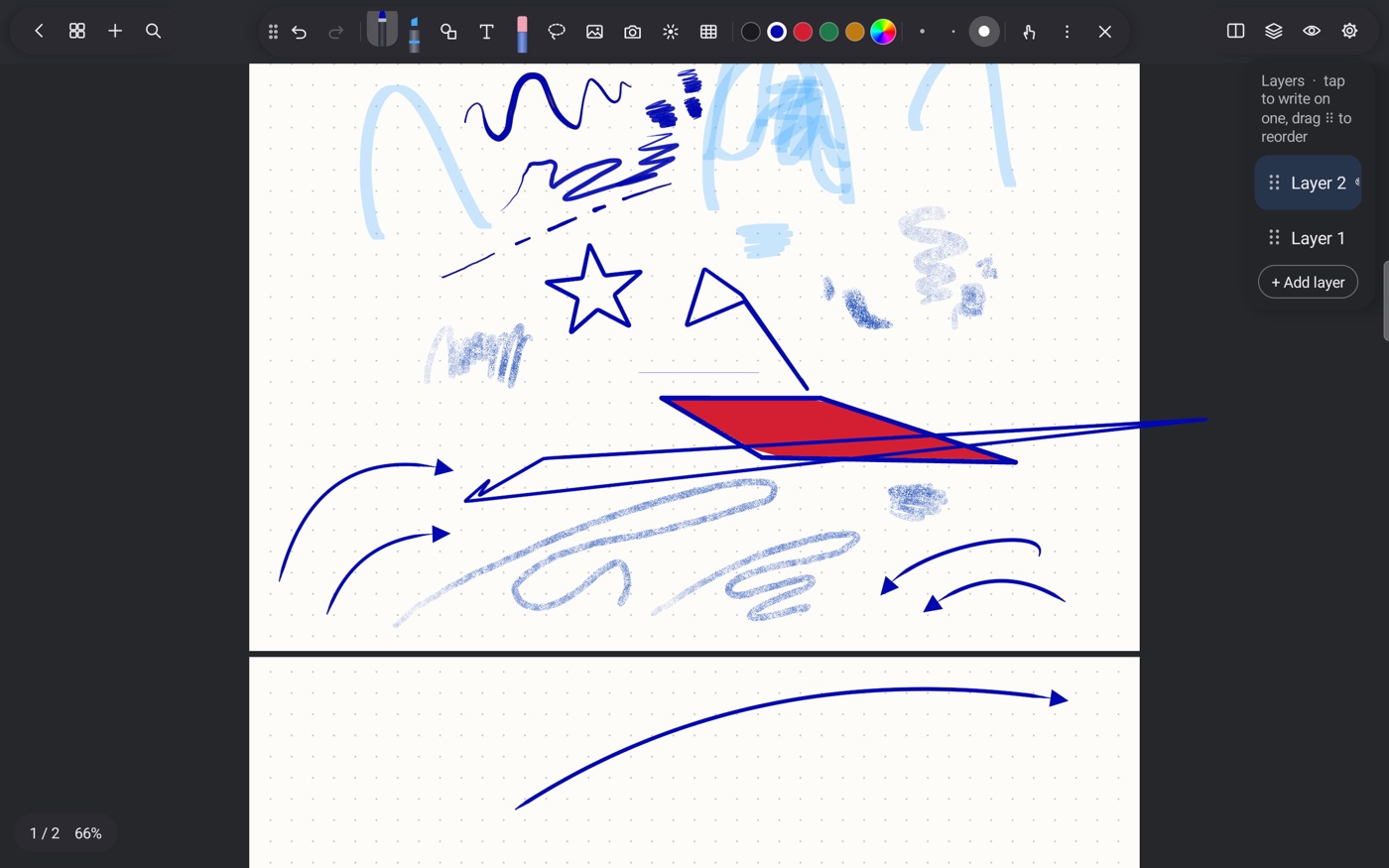
Six tools, each with its own way of leaving a mark.
Pressure opens the line. Optional sheen adds a second colour where the ink pools.
A simple, even line for everyday writing.
Pressure and speed shape the stroke. Adjust the bleed to soften the edge.
Soft graphite on the paper grain. Press harder for a darker line, go over it again to build it up, lean the pen to shade.
Round or chisel tip. Crossing strokes of one colour keep the same shade. Lean it for a soft wide shade.
Wavy, zigzag and double lines, or a little picture repeated along the line. Bring your own picture as an SVG.
Pressure and tilt work when your pen supports them. You can also write with an ordinary stylus or your finger.
A small sketch of how the pens behave in the app.
Press the size dot. Slide left or right.
Pause at the end of a stroke and it becomes a clean shape.
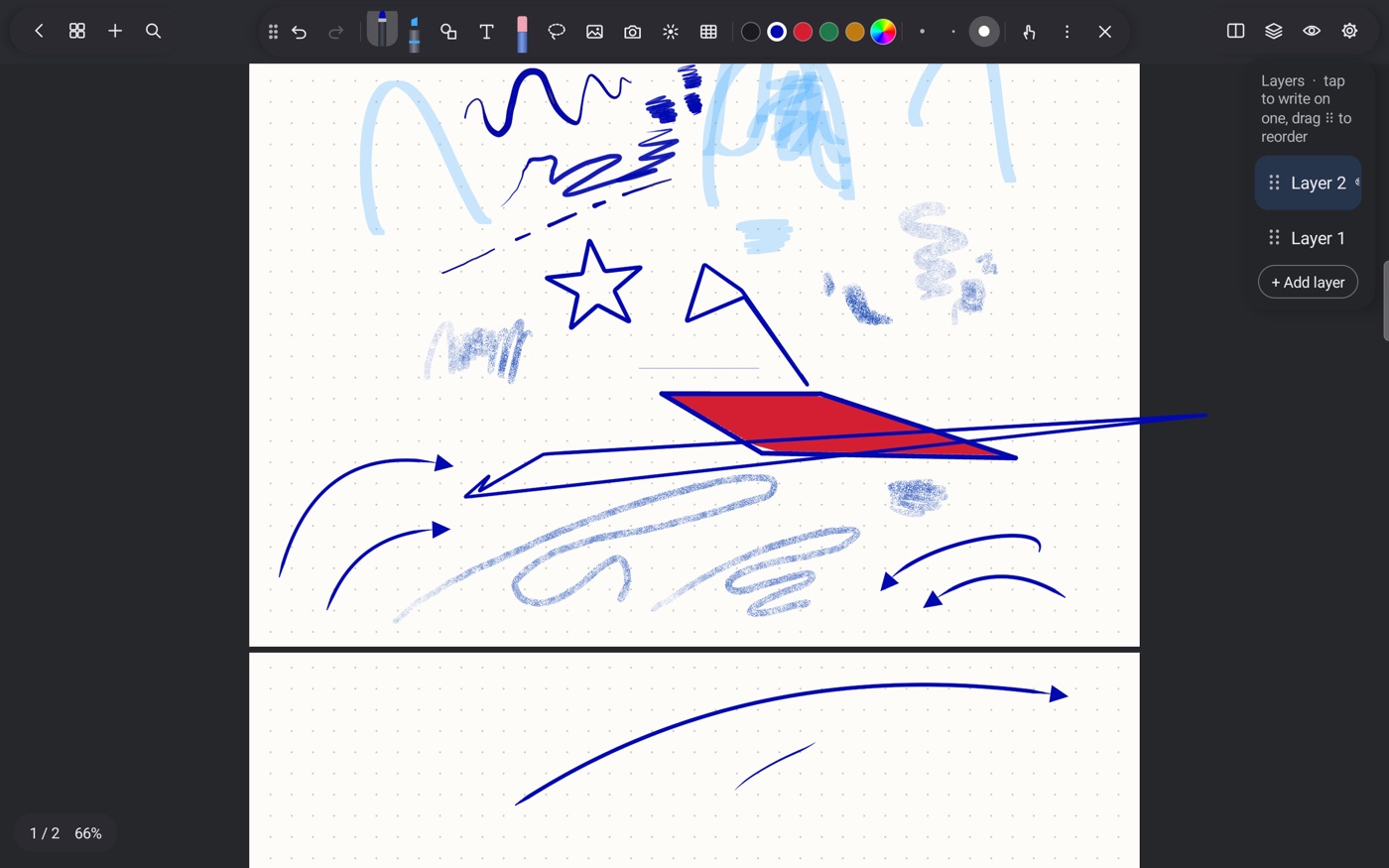
An ellipse stays an ellipse.Tap a second finger while holding for a perfect circle, square or regular polygon.
Arrows that stay attached.Curved arrows too. Connectors meet the shapes' outlines and follow when the shapes move.
Draw a line, ellipse or rectangle. Hold at the end.
Shift or a second finger makes it perfect.
Shapes and Bézier curves keep their editable points. Move a handle to change the bend.
Drag a colour from the toolbar into a closed area. The colour fills that part of your drawing.
Select two shapes. Keep their union, their overlap, or subtract one from the other.
Drag either shape. See what stays.
Things a notes app usually sends you to another program for. Here they happen on the page, and all of it works offline.
Write d/dx(x³ sin x) or ∫ x eˣ dx, lasso it, and the exact answer is written beside it. Definite integrals give a number.
Gamma, Beta, zeta, erf, Bessel J and I, Legendre, Hermite, Laguerre and Chebyshev polynomials, elliptic integrals, Lambert W, Si and Ei. Ready to use in sums and graphs.
Equations such as x² − 5x + 6 = 0 or sin x = 0.5 are solved, and roots are found to about 12 digits.
Write a matrix with brackets and it is read from its rows and columns. Determinant, inverse and eigenvalues, complex ones too.
y = f(x), implicit curves, parametric curves. Shade the area under a curve and its integral is written in. Fit a line, quadratic, cubic or exponential to your points, with R².
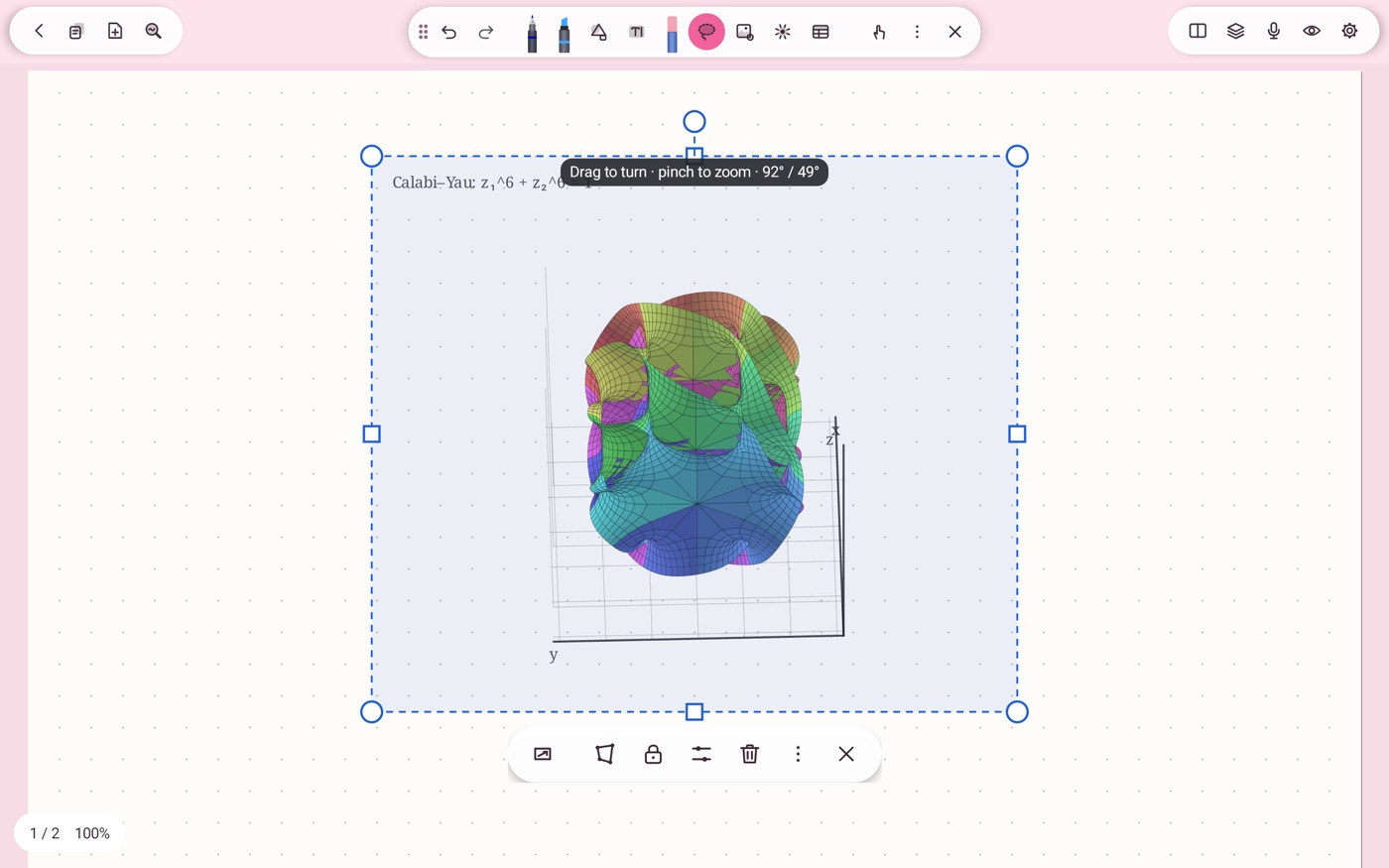
z = f(x, y) and parametric surfaces: sphere, torus, Möbius strip, Klein bottle, helicoid, even a Calabi–Yau slice. Turn them with a finger, right on the page.
LaTeX in text boxes and in graph labels. Written maths can become typed maths (experimental).
Wavy lines for photons and springs, zigzag and double lines, arrows that stay attached to their shapes. Draw a Feynman diagram or a free-body diagram in a minute.
A ruler and a protractor that lie on the page: read lengths and angles, draw straight along the edge, zoom to real size.
For the small calculations and the longer ones.
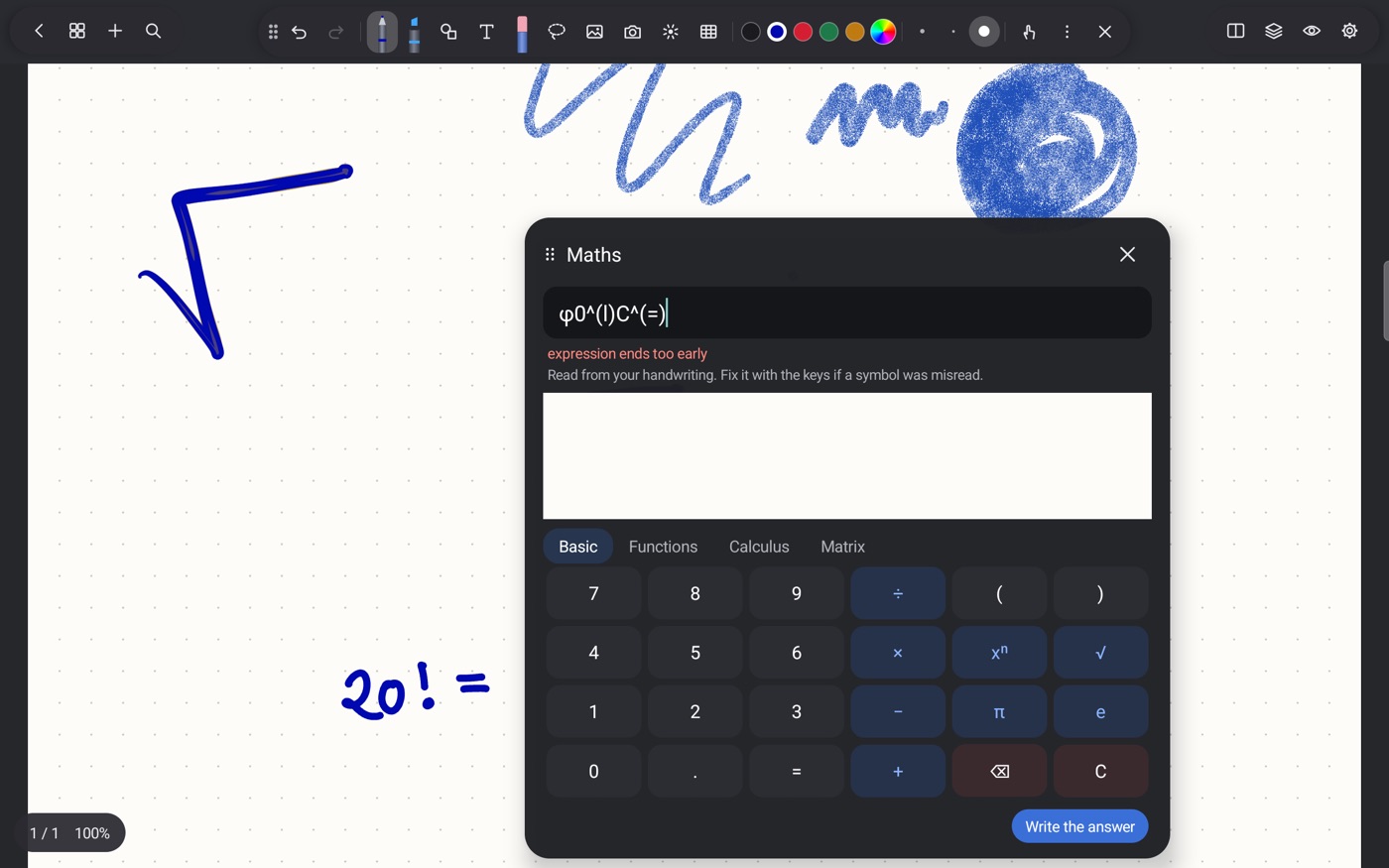
Select handwritten maths and the answer is written beside it. For example, 20! = 2432902008176640000.
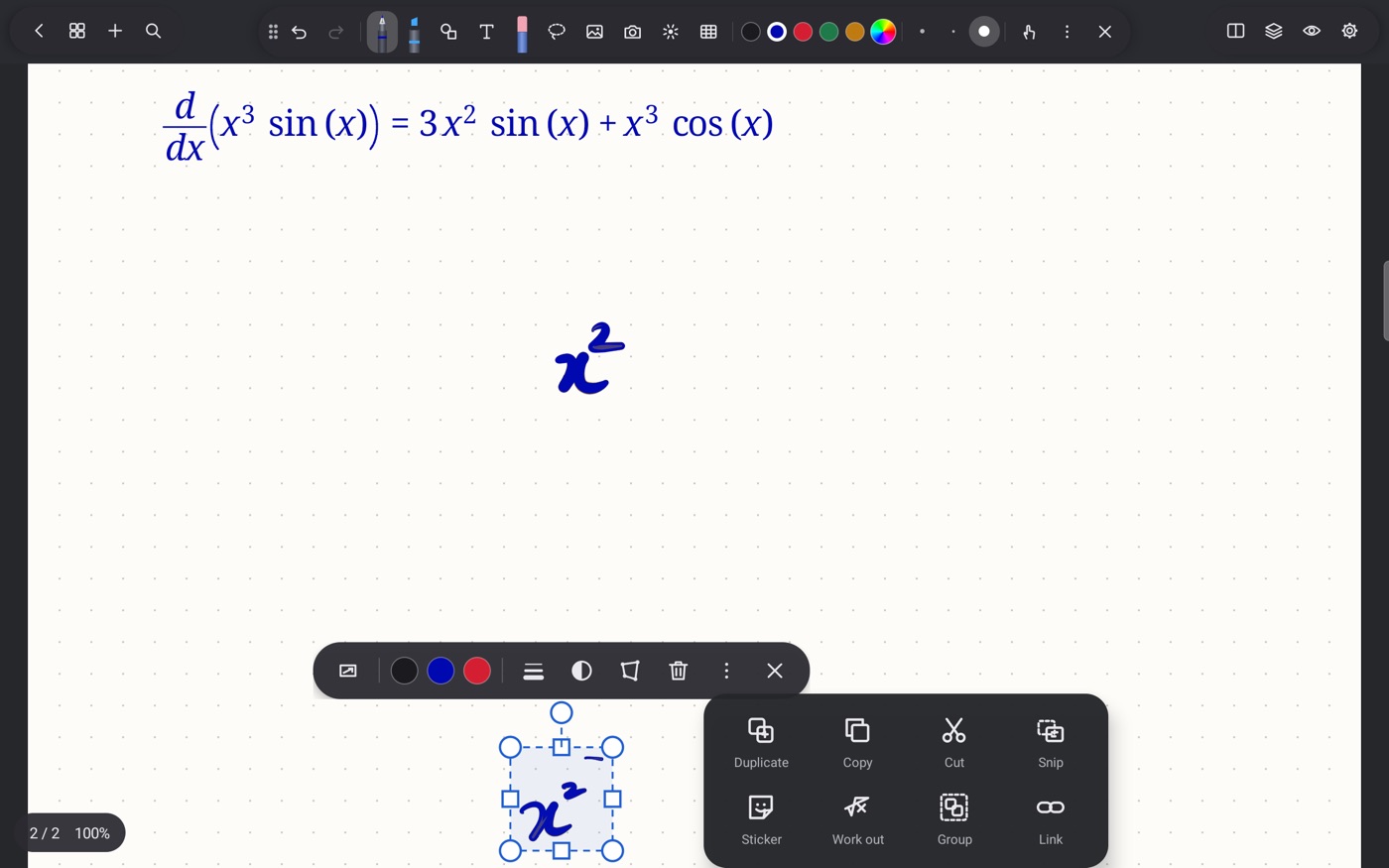
Use the Maths panel for derivatives, integrals and matrices. Find roots of equations to about 12 digits. Place typed maths wherever you need it.
ddx(x³ sin x) = 3x² sin x + x³ cos x
∫ x ex dx = (x − 1)ex
ln(e²) = 2
Turn a 3D surface with your finger. Drag and zoom a 2D curve.
The app keeps graphs sharp in exported PDF, even when you zoom in on the page.
Cells can feed each other. Change a number here and the formulas update.
| A | B | C |
|---|
Numbers, + − * / ^, cell references and SUM.
Try =SUM(A1:A3). Select a cell to edit its formula.
A paper to read, a sheet to solve, or notes to pass on.
See the notebook as a grid. Select pages to duplicate, move, export or delete. Drag to rearrange them.
A notebook can change its mind too.
Hide the rough work. Lock the background. Reorder, merge or duplicate layers as you go.
Record while taking notes. Each stroke remembers its moment.
Play the recording back and each stroke appears, whole, when the sound reaches the moment you wrote it. The strokes still to come stay faint. Tap a stroke to hear that part again.
The bit the lecturer said, right here →
A few stored strokes with timestamps. Press play, scrub, or tap the ink.
Small things that make a difference over a long day.
Open two notebooks side by side in split screen. Keep the reference beside the rough work.
Take a snip from your notes. Link related bits so you can find your way back.
Search what you wrote by hand. Handwriting is read on the tablet and never sent anywhere.
Back up to a folder, Nextcloud/WebDAV, Google Drive or a private GitHub repo. Save .sp, PDF and audio, with a folder for each notebook. Passwords are kept encrypted on the tablet.
Dark, Light, Cosmology, Anime and Durga Puja themes. Invert the pages when writing at night.
54 free stickers from Noto Emoji, under Apache 2.0. SpanNote works on any Android device running version 10 or newer, with or without pen pressure and tilt.
Twelve colours, twelve of the author's own drawings, or any photo. Write on the cover too, or leave it off.
Scroll down through the pages, or swipe sideways one page at a time, like a book.
Write with the pen in and around a text box and it is typed in for you.
The wand turns your written words into neat handwriting of the same size and colour, still ink you can erase. Typeset turns written maths into typed maths. Both are still learning.
14 / A small, one-time purchase
5 notebooks.
Every feature included.
One time. Unlimited notebooks.
Lifetime updates included.